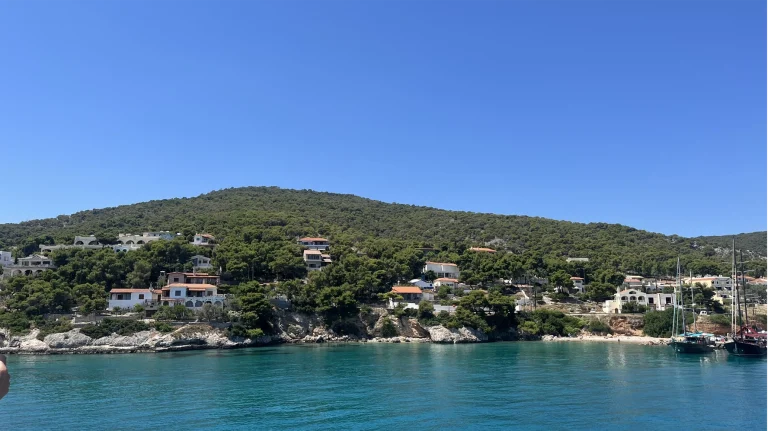
Aegina has a bigger personality than most islands this close to Athens, and the harbor is where you meet it head on. Neoclassical facades, a working waterfront, and pistachios sold on every second corner. If Agistri is the quiet stop, Aegina is the one with something to say.
Quick answer
What it is: The largest town in the Saronic Gulf, built around a curved harbor lined with 19th century neoclassical buildings.
Why it looks like that: Aegina served as the first capital of independent Greece, and the government of the day built accordingly.
What to do in two hours: Walk the waterfront, turn into the lanes behind it, buy pistachios, and sit down somewhere with a view of the boats.
Arriving at Aegina’s harbor
You step off into a proper town rather than a village. The waterfront curves away in both directions, ferries and fishing boats work the quay, and the buildings behind them are two and three stories of faded ochre, cream and pale rose.
The scale is the first surprise. This is a place people live in year round, with pharmacies and hardware shops and school children, and the tourism sits on top of ordinary life rather than replacing it.
Everything you need is within a ten minute walk of where you land. The waterfront runs one way toward the fish market and the lanes behind it, and the other way along the shore toward the edge of town.
Why the waterfront looks the way it does
Here is the piece of history that explains the architecture. When Greece won independence in the 1820s, Aegina became the country’s first capital, and the seat of government under Ioannis Kapodistrias.
The capital moved on within a few years, first to Nafplio and eventually to Athens, but the buildings stayed. What you are walking past on the waterfront is the architecture of a brand new state trying to look like one.
Aegina is the only island in the Saronic Gulf that was briefly the center of the country, and it still carries itself that way. The confidence in those facades is not accidental.
If you would like the context as you walk, a free one-hour guided tour of the neoclassical streets is included with the cruise for guests who want it, and the rest of the time ashore stays yours.
What two hours at the port gives you
Walk the neoclassical waterfront
Start by walking the curve of the harbor rather than heading straight inland. The full arc takes fifteen minutes and gives you the town in one continuous view, with the boats on one side and the facades on the other.
Look up above the shopfronts. The ground floors have been modernized into cafés and mini markets, while the upper floors still carry the original ironwork balconies, shutters and stonework.
Turn into the lanes behind the quay
The waterfront is the shop window. The streets one and two blocks back are where the town actually operates, with the fish market, bakeries, small tavernas and shops selling things nobody on a day trip needs.
These lanes are narrow and shaded, which matters in the afternoon. They are also where the prices drop noticeably compared with the tables directly on the water.
Buy pistachios, properly
You will pass a dozen shops selling them within five minutes of landing. This is the one souvenir from Aegina worth carrying home, and it is worth spending ten minutes on rather than grabbing the first bag you see.
More on what to look for in the next section, because there is a real difference between the good ones and the tourist packaging.
Sit down and watch the harbor work
Aegina is a genuinely good place to do nothing for forty minutes. Take a table facing the water, order coffee or something cold, and watch ferries come and go while the town moves around you.
Two hours goes quickly here. Build the sitting down into the plan rather than hoping there is time left at the end, because there usually is not.
Pistachios, and what to actually buy
Aegina pistachios are not a marketing story. The variety grown here carries protected designation of origin status under EU law, which means the name belongs to nuts actually grown on the island rather than anything packed nearby.
The reason is the ground. Aegina’s volcanic soil and dry climate produce a nut that is smaller, sweeter and more intense than the imported ones most people are used to.
What to buy, in rough order of usefulness. Plain roasted and salted in the shell, which is the benchmark and the one to taste before committing. Shelled and unsalted if you plan to cook with them. Pistachio butter, which is closer to a dessert than a spread. And the sweets, from pastelli and nougat to baklava made with pistachio instead of walnut.
One practical note. Ask for a vacuum-sealed bag if you have a flight ahead of you, since the fresh ones do not travel well in a warm suitcase.
Where to eat and drink around the harbor
The waterfront tables give you the view and the passing traffic. The tavernas in the lanes behind give you better value and more locals. Both are legitimate depending on what you want from the hour.
Seafood is the obvious order given the fish market a few steps away, though inside two hours a full sit-down lunch is optimistic. A plate of something small with a cold drink fits the time far better.
For coffee, take the freddo espresso rather than anything hot. It is what everyone around you is drinking in summer, and there is a reason for that.
Why Aegina works as the day’s second island
Order matters more than people expect on an island-hopping day, and Aegina earns the afternoon slot.
Agistri in the morning is small, relaxed and mostly about the water. Aegina is bigger, busier and more interesting to walk, which suits a point in the day when you have already swum, already eaten and want something for your eyes rather than your body.
The contrast is what makes the route work. Two similar islands would blur into one memory. A quiet port, an open-water swim at the islet of Metopi, then a historic harbor town gives the day three distinct chapters instead of three versions of the same one. Our guide to Agistri covers the first of them.
There is a great deal more to Aegina beyond the harbor for anyone who stays the night, and it deserves that longer visit on its own terms. For two hours ashore, the town is the right choice and the most rewarding one.
The island that used to run the country
There is something quietly funny about buying nuts in a town that was once the capital of Greece. Aegina wears its history lightly, which is probably why people warm to it faster than they expect to.
Athens Swimming Cruise gives you two hours here as the final stop of the day, after Agistri in the morning and the swim stop at Metopi in the middle, before the run back along the coast to Private Marina Delta Kallithea.
If you are still working out how to reach the Saronic islands at all, our guide to day trips from Athens by sea lays out the options.
See the Full Route →